By Caroline Harroe (Harmless CEO)
The release of the Equality and Human Rights Commission’s (EHRC) updated Code of Practice can feel like a heavy weight to carry. For many in the trans, non-binary and gender-expansive community, reading headlines about the exclusion of trans people from single-sex spaces doesn’t just feel like a legal update – it feels like a direct challenge to your right to navigate the world safely, comfortably and with dignity.
At Harmless, our core mission is to alleviate distress, reduce isolation and provide a sanctuary for anyone struggling with their mental health, self harm or thoughts of suicide. We know that systemic pressure, political debates and shifting guidelines have a real, exhausting impact on your day-to-day well-being.
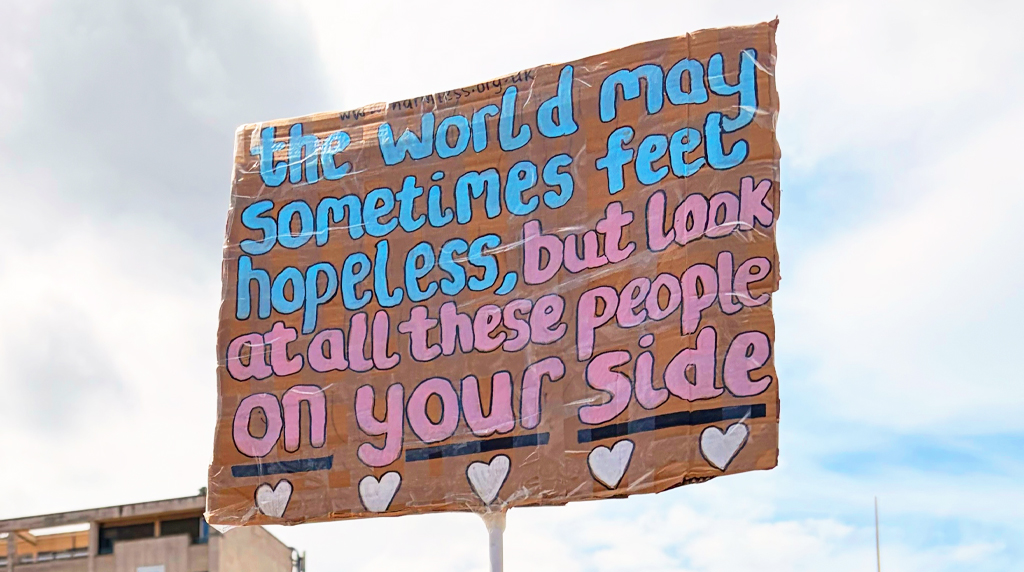
If you are feeling overwhelmed, anxious or hurt by this news, we want to pause and say clearly: You belong, your identity is valid, and you deserve to feel safe in public life.
Here is a supportive breakdown of what the guidance actually says, what it means for your practical safety and where you can find support right now.
Understanding the Guidance (Without the Media Noise)
The EHRC’s updated code follows a previous Supreme Court ruling regarding how ‘sex’ is defined under the Equality Act 2010. While the headlines have been stark, the actual document contains vital nuances, legal limits and protections that service providers must still follow:
- Gender Reassignment Remains a Protected Characteristic: The law still explicitly protects trans and non-binary people from direct discrimination, harassment and victimisation.
- The ‘Proportionality’ Test Still Applies: Service providers cannot simply implement blanket bans out of nowhere. To alter or restrict access to a service, a provider must prove it is a ‘proportionate means of achieving a legitimate aim’ (such as safety or privacy). Cost or prejudice alone are not legally sufficient reasons.
- The Expectation of ‘Third Spaces’: The guidance explicitly states that service providers and public spaces should provide practical alternatives – such as gender-neutral or individual unisex facilities – so that trans individuals are not put at risk of distress, safety hazards or exclusion.
- Challenges in Practice: Many organisations, businesses and hospitality venues have already expressed that strict, blanket exclusions are unworkable, unnecessary and counterproductive to a welcoming environment.
Navigating the Emotional Impact
It is completely normal to feel a sense of ‘hyper-vigilance’ right now. When the media and public bodies debate your right to use a bathroom, a changing room or a healthcare space, it triggers a survival response. You might find yourself checking your surroundings more, avoiding public places or feeling a deep sense of rejection.
If the noise is becoming too loud, remember to protect your peace:
1. Step away from the comments sections: The debate online rarely reflects the kindness and allyship available in real life.
2. Lean on your community: You do not have to process this fear alone. Surrounding yourself with people who see and validate the real you is a powerful buffer against systemic stress.
3. Acknowledge the exhaustion: It is tiring to be resilient all the time. Give yourself permission to feel angry, sad or simply fed up.
You Are Not Alone: Where to Find Support
If this news is impacting your mental health, causing you to self harm or making you feel hopeless, please reach out. There are people waiting to listen without judgment.
Local & Specialist Trans Support
Notts Trans Hub
A brilliant local grassroots resource offering social activities, support groups, and a network of trans and non-binary community spaces in Nottinghamshire.
Gendered Intelligence Support Line
A confidential support line run entirely by trans and non-binary people to support you through difficult times.
Phone: 0800 640 8046 or WhatsApp: 07592 650 496
The Pastel Project
A Nottingham-based, trans-led volunteer organisation working tirelessly for trans and non-binary acceptance and inclusion.
Crisis & Mental Health Support
Harmless & The Tomorrow Project
We provide life-saving, compassionate support for anyone experiencing self-harm or suicide crisis. You can self-refer directly to our services via our website (harmless.org.uk) or visit us at The Sanctuary in Nottingham.
Switchboard LGBT+ Helpline
A safe space to talk about anything on your mind. All volunteers identify as LGBTQIA+.
Call: 0800 0119 100 (10am–10pm daily).
The world can feel incredibly noisy and hostile right now, but please remember that a legal document does not change your worth, your reality or the beauty of who you are. We are here, our doors are open and we will continue to stand beside you.